Vote expected on 12 November: Spain's parliament decides on the housing decrees. Owners' groups say many owners are holding flats back until then. Call their bluff. Don't be bullied into submission. Don't be the lever.

What to do now

How we got here, and the myths that hide it

This crisis isn't bad luck. It's being made.

What happened, in order, with sources. Then nine things you'll hear, and what the evidence shows.

This page in: Català · Español

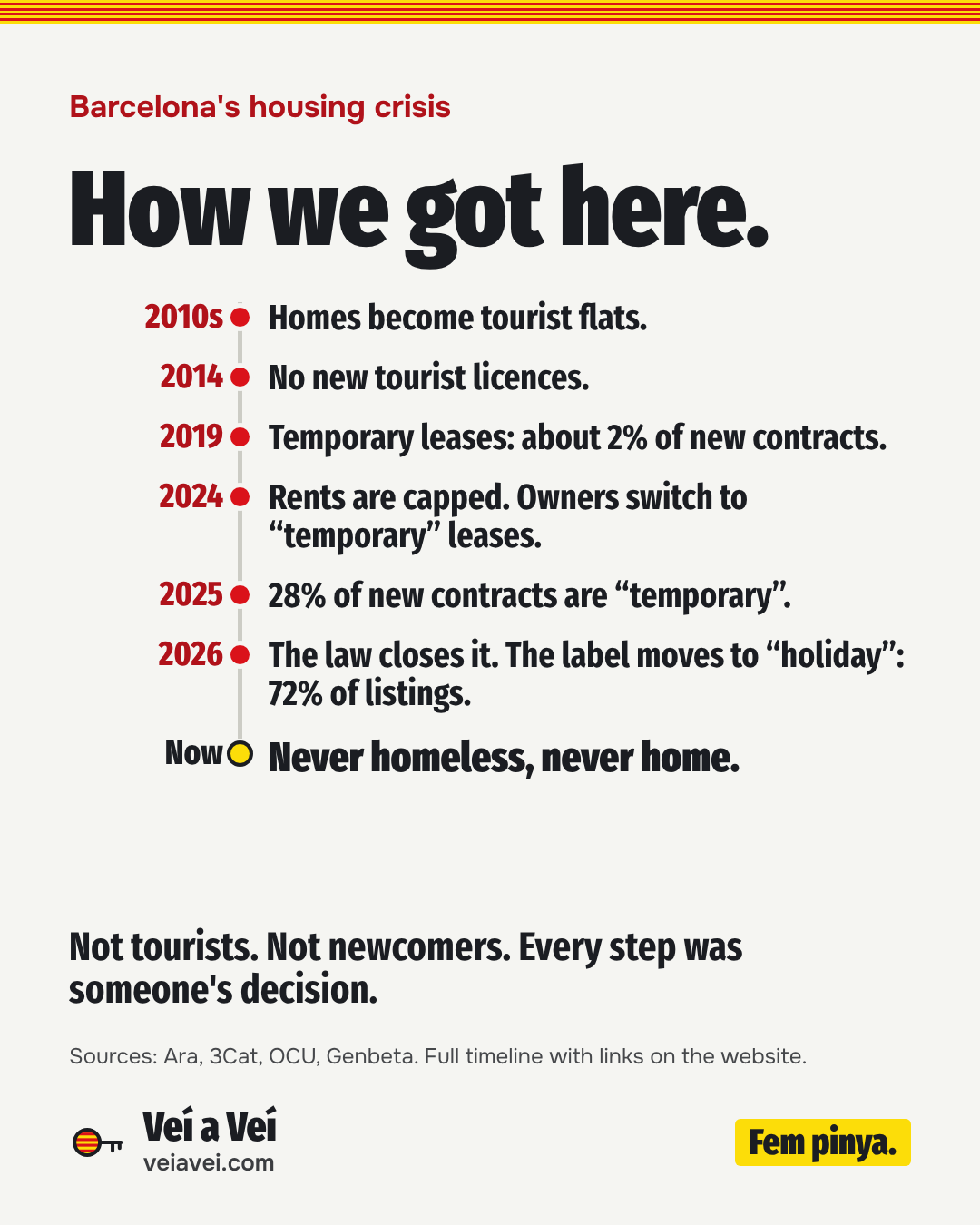
How we got here

People are being told many different stories about who's to blame. Here is what happened, in order, with a source for every step. Tourists didn't do this. Newcomers didn't do this. At every step, someone made a decision, and the timeline says who.

  1. 2010s

    Homes become tourist flats.

    Owners learned that a flat rented to tourists by the night earned far more than one rented to a neighbour. Thousands of homes became tourist apartments. Researchers found that Airbnb activity pushed up rents across Barcelona, by about 7% in the neighbourhoods where it was most concentrated (Journal of Urban Economics).

    Decided by: owners and investors. Not the visitors, who came to see a beautiful city.

  2. 2010–2014

    The city stops new tourist licences.

    Barcelona stopped granting new tourist-flat licences in Ciutat Vella in 2010, and in the rest of the city in 2014 (Genbeta).

    Decided by: Barcelona City Council.

  3. 2019

    Temporary leases are a small niche.

    Seasonal leases, usually from 32 days to 11 months, were about 2% of Barcelona's new rental contracts (Ara) and 13% of listings (Ara). There was no rent cap to dodge yet, so there was no reason to call a home temporary.

  4. March 2024

    Rents are capped.

    Catalonia applied Spain's new rent cap to Barcelona and other stressed areas. One 30 m² flat in Gràcia, listed at €1,550 a month, had a legal cap of €700 (3Cat).

    Decided by: the Generalitat, under Spain's 2023 housing law.

  5. 2024–2025

    Tourist flats get an end date.

    The city announced that all of Barcelona's roughly 10,000 tourist-flat licences will end in November 2028. The Supreme Court rejected an appeal against the plan (Genbeta), and the Constitutional Court upheld the Catalan decree behind it (Moncloa.com).

    Decided by: Barcelona City Council and the Generalitat, upheld by the courts.

  6. 2024–2025

    The first loophole: “temporary” leases.

    Seasonal leases were outside the cap, and outside a normal lease's right to stay 5 or 7 years. New temporary contracts in Barcelona rose 62% in the year after the cap (Ara). In the second quarter of 2025 they were 28% of new contracts (Ara), up from about 2% in 2019. Long-term listings fell by two thirds between 2019 and 2024 (Ara).

    Decided by: owners, and the agencies that write the contracts.

  7. 1 January 2026

    The law closes it.

    Catalan law (Llei 11/2025) put temporary leases under the rent cap. The contract must state its real purpose, and the owner must prove it. Only real holiday or leisure use is exempt (idealista). Faking the purpose can be fined up to €900,000 (idealista).

    Decided by: the Parliament of Catalonia.

  8. March 2026

    The label moves to “holiday”.

    Almost three months after the new law, 72% of Barcelona's rental listings were still “temporary”: 1,908 against 737 long-term (OCU). Newcomers who need a home are asked for a “reason” they're only here for a while (Ara), and pay about 17% more per square metre (OCU).

    Decided by: owners and agencies.

  9. July 2026

    Enforcement, barely.

    The Generalitat imposed its first three rent-cap fines, of €30,000 each, with 654 cases still open (idealista). Fines for keeping homes empty, possible since 2022, had not been issued once in three years (Ara).

    Decided by: the Generalitat, which decides what gets inspected.

  10. October 2026

    Flats are held back.

    A new Spain-wide decree took effect on 8 October, requiring a real, provable reason for any temporary lease (OCU). Owners' associations said openly that many owners would keep long-term flats off the market until parliament votes (Público).

    Decided by: owners and their associations.

  11. 12 November 2026

    Parliament votes.

    Spain's parliament is expected to vote on the decrees (La Región). Catalonia's own law on temporary leases stays either way (OCU).

    Decided by: Spain's parliament.

  12. Now

    Never homeless, never home.

    Newcomers move from one short lease to the next, with a new deposit and often new agency fees each time, because the rule that makes owners pay those fees doesn't cover temporary leases (idealista). Locals are pushed out of the rental market: long-term listings fell another 22% in a year (idealista). And each side is told to blame the other.

    What happens next is decided by us.

Every step was a decision. Every one of them can be refused.

Barcelona's rooftops in the evening light, with the Sagrada Família in the distance.

The city we're defending.

Myths, and what's true

Nine things you'll hear about Barcelona's housing, and what the evidence shows.

“There just aren't enough flats.”

The flats exist. They've been relabelled or held back.

In March 2026, 72% of Barcelona's rental listings were "temporary": 1,908 temporary flats against 737 long-term (OCU). Between 2019 and 2024, temporary leases went from 13.1% to 39.6% of listings while long-term listings fell by two thirds (Ara). Since October, owners' associations have said openly that many owners will hold flats back until parliament votes (Público).

Barcelona needs more homes in the long run. But the long-term flats people can't find today are on the market under another label, or being kept off it on purpose.

“It's the same in every big city.”

Housing is hard in many cities. This squeeze has a specific cause.

When Catalonia capped rents in 2024, new temporary contracts in Barcelona rose 62% in a year (Ara). When Catalan law brought temporary leases under the cap in January 2026, the label moved to "holiday", the only exemption left (idealista). The loophole moved each time a rule closed it.

A cause that specific has a specific fix: enforce the law, know your rights, and refuse the fake lease.

“Leave it to the free market. Rules only make it worse.”

No market ever made itself fair. People did, and then the law followed.

For centuries, Catalan peasants called remences were tied to the land by their lords' “evil customs”, and had to pay to leave (Wikipedia). The lords never gave those customs up. It took two peasant wars before the Sentència de Guadalupe outlawed the worst of them in 1486, and even then the peasants had to buy their freedom (Wikipedia).

In 1919, a working day in Barcelona could run past 14 hours. The companies didn't choose shorter ones. More than 20,000 workers struck La Canadenca and the city's power, water and tram companies for 44 days, more than 3,000 were jailed in Montjuïc, and on 3 April 1919 Spain adopted the eight-hour day, one of the first countries in Europe to do so (3Cat).

Housing has never been a market without rules. Deeds, contracts, courts and evictions are all rules, enforced by the state. The only question is who the rules protect. A city where most people rent from a few, and the rent eats most of the wage, isn't a free market. It's a manor (a thriving city).

And today's “holiday” label isn't the market at work. It's a way around a law the Catalan parliament passed.

“Expats are driving up rents.”

Newcomer families are being exploited, then blamed for landlord greed.

Newcomers are often vulnerable: less choice, less time to find a home, and less knowledge of local law. They often have no real choice, and they don't set rents or write contracts. They are being robbed: temporary flats cost about 17% more per square metre (OCU). And the money flows upward: about 2% of landlords hold about 36% of main-residence rentals (El Salto).

The "expat effect" story (Ara) turns neighbours against each other while the money goes elsewhere.

“Owners have no choice. The rules are driving them out.”

Owners aren't losing money. Holding flats back is a choice.

Barcelona's gross rental yield is 5.2% (Infobae). An empty flat still costs property tax, building fees and upkeep, which is why lawyer and researcher Manuel Gabarre calls the threat to keep flats empty "un farol", a bluff (Público). The city's rental pool guarantees the rent and cuts property tax by half for owners who rent long-term (city leaflet).

Catalan fines for empty homes apply only to large owners after two years, and none were issued in the first three years (Ara). Holding a flat empty for a few months is legal. Calling it "the market" isn't honest.

“Holiday and temporary leases are just what the market offers now.”

A "holiday" label on a family's home is a dodge, and it can be illegal.

Since 1 January 2026, temporary leases in Catalonia are under the rent cap, and only real holiday or leisure use is exempt. The contract must state the purpose and the tenant's home elsewhere, and the owner must file proof of the temporary reason (idealista). Faking the purpose can be fined up to €900,000 (idealista).

“If the decrees fall on 12 November, the protections go too.”

Catalonia's own law stays, whatever the vote.

The vote is about Spain-wide decrees. Catalan law on temporary leases (Llei 11/2025) stays in force either way, and the national decree itself says it doesn't override regional rules (OCU). Holding flats back won't bring the fake temporary lease back in Catalonia.

“Once you've signed a holiday lease, you have no rights.”

The label doesn't decide. The real purpose does.

Courts look at what a lease really is, and have reclassified disguised temporary leases as housing leases (OCU). Only a judge can order you out, and lockouts can be a crime (Garon Abogados). It's strongest when the flat really is your only home; if your temporary reason was real, it can go the other way (OCU). Read what the law says.

“Nothing can be done.”

Barcelona has won this kind of fight before.

Neighbours won parks, schools and transport street by street from the late 1960s (UB). In 2024 and 2025, tens of thousands marched for lower rents (3Cat), and tenants' unions pushed for the Catalan law that now covers temporary leases. By July 2026, 654 cases for breaking rental rules were open (idealista).

A shortage that's made can be unmade. Every tenant who knows their rights, every agent who refuses, every owner who rents fairly takes it apart.

And there's a model ready to build: housing co-ops that rent at cost, already working in Catalonia. What we build instead.

Now you know. Pass it on.

Send this page to the next person who blames the newcomers, or says nothing can change.

The plan

The plan

  1. 1Don't sign a fake lease.Now
  2. 2Convert the ones already signed.Next
  3. 3We rent from ourselves.For good
  4. 4The barri thrives.The result

Instead of lining the pockets of the few, we all thrive together.